Homeschooling guide

What is positive reinforcement and how to apply it with your children

Positive reinforcement helps children repeat good behaviors through praise, rewards, and routines that are easy to apply at home. When your child receives attention, recognition, or a reward for doing something well, their brain learns that this behavior is worth repeating.

In this guide you will find a simple explanation of what positive reinforcement is in child psychology, why it works so well in education, and practical examples for applying it at home with daily habits such as homework, tidying, hygiene, or living together. You will also see how the Motikids app helps you use it consistently with your children.

Father and child using positive reinforcement at home

What is positive reinforcement in children?

When we talk about positive reinforcement in children, we mean a very simple educational strategy: recognizing and rewarding the behaviors we want to see repeated. Instead of focusing only on what the child does wrong, we focus on what they do well and turn it into something valuable for them.

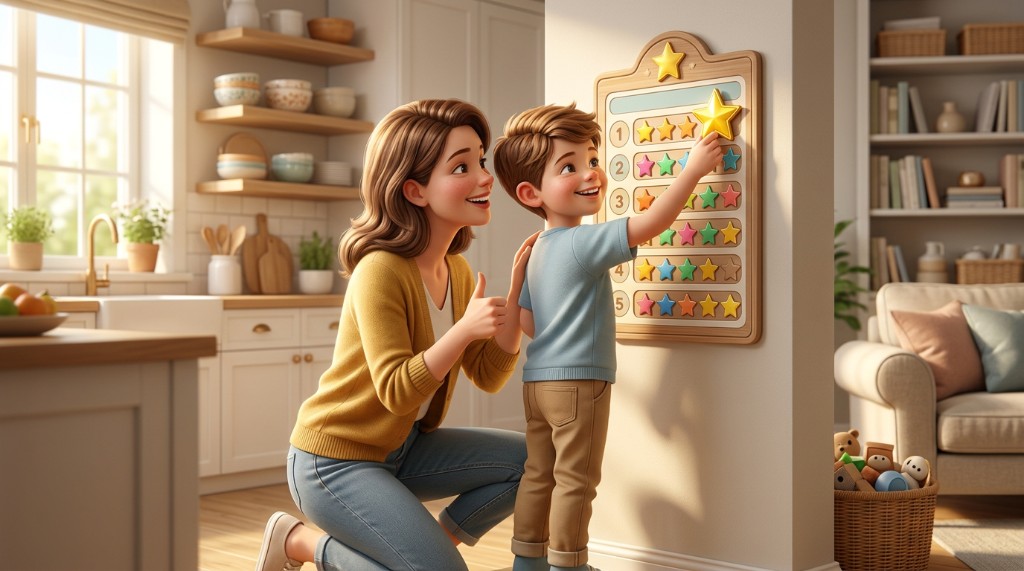
From child psychology, we know that children tend to repeat what brings them attention, affection, recognition, or rewards. If every time they pick up their toys they hear "Thank you, you did great!" and also earn a star or a point, their mind associates that behavior with a pleasant experience. That is, in essence, positive reinforcement.

Unlike other approaches more focused on scolding or punishment, positive reinforcement seeks to help the child understand: "When I do this, something good happens". That message is much clearer and more motivating than "if you do not do it, I will punish you". That is why positive reinforcement in education is so effective for creating lasting habits.

At home, positive reinforcement can be applied to almost any behavior: completing homework, turning off the screen at the agreed time, speaking respectfully, going to the bathroom before bed, or preparing the backpack for the next day. Later you will see examples of positive reinforcement for each of these situations.

Why positive reinforcement works in child psychology

Positive reinforcement is not an educational trend, but a basic principle of the psychology of learning: we all tend to repeat behaviors that bring us pleasant consequences.

Motivation and willingness to make an effort

When the child feels that their effort is seen, recognized, and celebrated, their internal motivation increases. They no longer do things only "to avoid being told off", but because they feel capable and valued.

Improved self-esteem

When receiving messages such as "you did a good job" or "I like how you tried", the child builds a more positive image of themselves. This is key for daring to take on new challenges.

Fewer conflicts at home

When the adult stops repeating only "do not do that" and starts reinforcing what they do want, arguments and punishments decrease. The atmosphere at home becomes calmer and more cooperative.

Using positive reinforcement at home does not mean allowing everything or avoiding limits. It means that, once the rules have been set, we devote more energy to recognizing progress than to pointing out mistakes. This way of educating is especially effective in primary school, when children are building their habits and their way of relating to authority.

How to apply positive reinforcement in daily life

Positive reinforcement works best when it is applied in a clear, coherent, and consistent way. These steps can help you use it in everyday routines.

1. Define what you want to reinforce

It is not enough to think "I want them to behave better". Choose observable behaviors, for example:

In Motikids, these behaviors become specific tasks that you can mark each day, making it much easier to track positive reinforcement.

2. Explain the rules in advance

Before asking for the change, talk to your child calmly. Explain:

  • Exactly what you expect (for example, "when the 8:30 alarm goes off, you brush your teeth").
  • What type of positive reinforcement they will receive when they do it.
  • What happens if it is not achieved that day (there is no extra punishment, there is simply no reinforcement).

Children need anticipation and clarity. The more specific the rule is, the less room there will be for argument.

3. Reinforce immediately

Positive reinforcement is much more powerful when it arrives right after the behavior. A comment, a smile, a gesture of complicity, or a star in the app tells the child: "what you just did matters".

In practice, this can be as simple as:

  • “I saw that you started your homework without me reminding you. Good job!”
  • Mark in Motikids that they have completed the task and let them see how they earn a star.

4. Review progress and celebrate small steps

Do not wait for the change to be perfect. Positive reinforcement in education is based on valuing each step forward: a day with fewer protests, a task that starts earlier, an argument that ends faster.

With tools such as the tips list and Motikids tracking, you can review together how you are progressing and celebrate the effort, not only the final result.

Examples of positive reinforcement at home

These positive reinforcement examples show how small gestures can make a difference in everyday education.

Positive reinforcement for homework

  • Before starting the afternoon, you agree together: "When you finish your homework, you will earn a star and you can choose tonight's story."
  • When you finish, avoid focusing solely on the mistakes. Say something like, "You finished on time and without complaining, that's a great improvement."
  • Mark the task as completed in Motikids and let your child see how they accumulate points towards a bigger prize.

Positive reinforcement for tidiness and household chores

  • Define simple tasks: "pick up toys", "set the table", "put clothes in the laundry basket".
  • Each time they do it without protesting, reinforce it with phrases like: "Thank you, this makes everything go faster."
  • Use a star, points, or reward chart in the app to show how their effort has an impact.

Positive reinforcement for hygiene habits

Positive reinforcement for family life

  • Set the goal as: "speak without yelling" or "resolve conflicts without hitting".
  • When someone manages to control themselves in a difficult situation, make the achievement explicit: “You got angry, but you were able to talk without shouting. That's very important.”
  • Record these moments in Motikids so they see that their self-control also counts and is reinforced.

Common mistakes when applying positive reinforcement

Like any educational tool, positive reinforcement can lose effectiveness if it is used unclearly or inconsistently. These are some common mistakes and how to avoid them.

Reinforcing irregularly
One day you reward the behavior and the next, even though they did it just as well, you say nothing. The message becomes confusing and the child does not know what to expect.
Focusing only on the material reward
Positive reinforcement is not only gifts or sweets. Sincere praise, time together, and privileges (choosing the game, the movie, or the activity) are just as powerful or more so.
Expecting immediate changes
Building a habit takes time. If you abandon positive reinforcement after a few days, it is difficult for the new behavior to become established.
Reinforcing the wrong behaviors
Sometimes, without realizing it, we give more attention to tantrums than to calm moments. The goal of positive reinforcement in children is to reverse that proportion: more attention when they behave as we want, less when they try to get attention with yelling or complaints.

How Motikids helps you apply positive reinforcement

Maintaining a system of positive reinforcement at home can be difficult if you try to do it only with paper or memory. The Motikids app is designed precisely for that.

Define clear habits

You can choose from more than 60 educational habits and rules in the tips list or create your own. Each behavior is clearly defined so your child knows what is expected of them.

Track progress with stars

Every time your child completes a task, you mark it in the app and they earn stars. This turns positive reinforcement into something visual, concrete, and very motivating for children.

Connect effort and reward

When they collect enough stars, they can exchange them for rewards agreed on as a family: screen time, a special plan, choosing dinner... This makes the logic of positive reinforcement clear and consistent.

If you want to go deeper into how to use our content, you can visit the educational tips page, where you will find practical ideas for applying positive reinforcement in education according to the behavior you want to work on.

You can also see the complete guide to the weekly rewards chart, with the real flow for adding stars, editing completions, and giving rewards from Motikids.

Tip categories

Explore all the guides by topic to apply positive reinforcement in your daily life:

Frequently asked questions about positive reinforcement

Common questions parents ask when they start using positive reinforcement at home.

How long does it take for positive reinforcement to be noticeable?

It depends on the child's age, the habit you want to change, and your consistency. Many families notice initial changes within 2–3 weeks when they apply positive reinforcement daily and maintain the same routines. With Motikids, it's easier to be consistent because you see progress week by week.

Does positive reinforcement create "reward-dependent" children?

No, as long as you combine rewards with praise focused on effort and gradually reduce the frequency of the material reward. The goal is for the child to feel proud of what they achieve, not only of what they receive. Positive reinforcement, when applied well, strengthens autonomy, not dependence.

What do I do if my child refuses to cooperate?

It is normal for there to be resistance at first, especially if the child is used to arguing about every rule. In these cases, it helps to start with very simple habits, offer two or three options so they can take part in the agreement, and reinforce any sign of cooperation. If one day does not go well, avoid extra punishment and return to the plan the next day.

Can I use positive reinforcement with siblings of different ages?

Yes, but by adapting the type of tasks and rewards. Younger children tend to respond better to quick, visual rewards, while older children can handle longer-term goals and less frequent rewards. At Motikids, you can set up different tasks and rewards for each child.

Positive reinforcement: small steps, big changes

Educating with positive reinforcement does not mean everything is perfect or that conflicts disappear, but it does transform the way you support your children: you move from focusing on mistakes to noticing and reinforcing progress.

Start with a single behavior, apply positive reinforcement consistently, and rely on tools such as Motikids to record progress. With patience, clarity, and affection, the habits that are difficult today become natural routines for the whole family.

I want to try Motikids